Community Spotlight:Meet with Folasewa Sulaimon
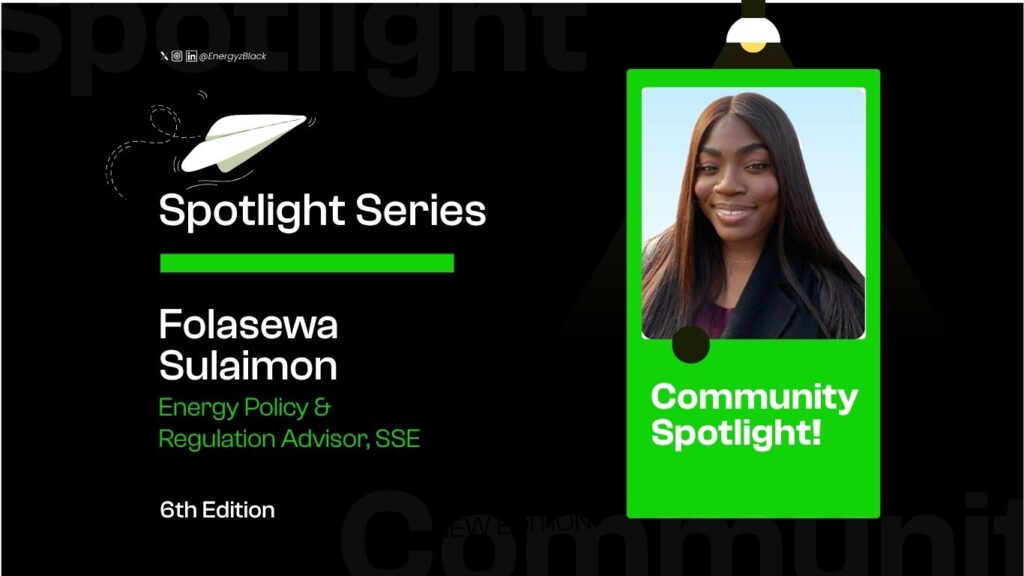
26th May 2026 | Energyz Black
A periodic publication aimed at highlighting, engaging with, and empowering Black professionals in the energy sector.
Folasewa is a Regulation Manager at SSE, supporting the thermal business working across hydrogen and CCS projects. She previously held a role at National Grid focusing on interconnector portfolio and the cap and floor framework. She is passionate about how policy and regulatory design can unlock the energy transition.
Q. Could you walk us through your journey into the UK energy sector: you studied law, and then moved into energy policy and regulation?
Folasewa: My journey into energy started during my undergraduate years while interning at a law firm. That was my first exposure to the sector not just oil and gas, but electricity supply, infrastructure, and renewables. Seeing how law and regulation could shape electricity access really sparked my interest and pushed me further toward the sector.
After law school, I returned to the firm and worked on electricity-related matters, advising on PPAs, regulation, and investor requirements. A turning point came when we began working on a project that exposed me to the wider thinking behind energy markets and policy design, not just the legal framework itself. That experience led me to pursue a Master’s in Energy Law and Policy at the University of Dundee.
I was in Scotland during COP26, and the conversations around the energy transition and reskilling for a low-carbon future were incredibly inspiring. After graduating, I joined National Grid, working on interconnectors and regulatory frameworks, before moving to SSE in 2024, where I was drawn to the emerging hydrogen space and the opportunity to help shape a new area of energy regulation from the ground up.
Q. What excites you most about your roles at National Grid and now SSE?
Folasewa: It’s always been about how policy, law, and regulation play a critical role in making energy projects happen. At National Grid, the cap and floor framework is what guarantees investors return on their investment. Without such framework, projects may not be commercially viable which has a ripple effect on the UK achieving its decarbonisation goals.
At SSE, I was particularly drawn to the fact that the company is active across different technologies in the industry – renewables, gas generation, networks and gas storage. My role involves engaging with government/the regulator (Ofgem)to support the deployment of hydrogen and other thermal business projects. The excitement for me lies in the fact that my work directly contributes to the energy transition.
Q. What skills are most critical for young professionals looking to build a career in energy policy and regulation?
Folasewa: Curiosity first. When you’re not an engineer, you need to actually say “explain it to me”, and that curiosity helps you give better advice and frame positions more effectively.
Then adaptability. At National Grid, there were established frameworks and clear licence conditions you could refer to. Moving into hydrogen at SSE was very different because much of the market is still being developed. I remember asking if there was something I could read, and being told, “not really.” It’s taken alot for me to adapt to that style of abstract thinking.
Tied to that is resilience and the ability to push through the discomfort of being a novice.
So is stakeholder engagement. A lot of the role involves managing relationships across teams, understanding different perspectives, and knowing who can help move things forward. Writing is another key skill because you are constantly drafting consultation responses, applications, and policy positions.
Q. For graduates without direct experience, how can they position themselves for roles at organisations like National Grid or SSE?
Folasewa: Focus on transferable skills. Curiosity, stakeholder engagement, diligence, and resilience can come from many different environments. When I joined National Grid, I don’t think they hired me on the basis of my degree alone. It was the experience from the law firm, engaging stakeholders, carrying out market surveys, and drafting applications for clients that helped. I’ve had colleagues who joined the energy industry from non-technical/engineering backgrounds like teaching and even the police force. The key is being able to show how your experience applies in a different setting.
Also, be aware of the industry. To stay informed, I subscribe to NESO’s and Ofgem’s LinkedIn pages, follow people who write great market summaries and law firm thought leadership pieces.
Where possible, speak to hiring managers before applying. Try to understand what they are looking for and shape your application around that. Beyond that, keep trying. Even applications that do not work out usually prepare you better for the next opportunity.
Q. What has diversity been like in the energy industry, and have you seen it change?
Folasewa: Since COP26, there has been a lot of pushbacks on DEI initiatives, and some companies have become more cautious or pragmatic in how they approach the topic. Immigration policy changes have also made things more difficult in some ways.
On gender, there is still a perception that energy is mostly engineering which could suggest that its male dominated. People often hear that I work at SSE/energy and immediately assume I am an engineer. In reality, the industry needs people across policy, regulation, finance, and commercial roles too. I think broader awareness of that could help improve representation. On the technical side, there are still more male engineers than female so there is certainly a lot more needed to encourage more women to join the industry.
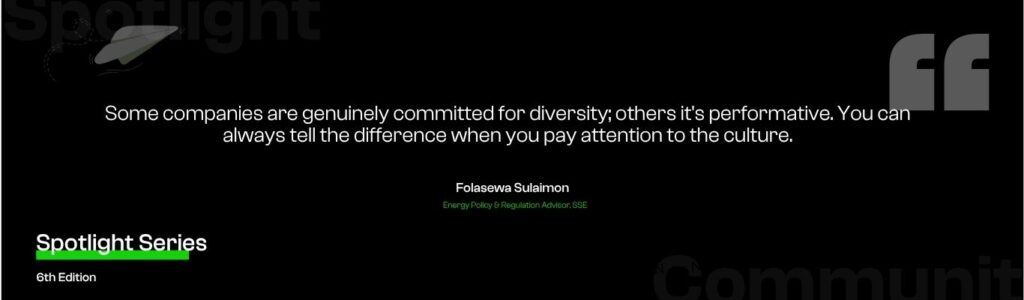
I appreciate what Energyz Black does, not only helping Black professionals get into the industry, but sensitising companies themselves to the value Black talents can offer. That’s what actually helps moves the dial.
Q. What significant barriers limit the growth of Black talent in the industry?
Folasewa: Not dreaming big enough. The company you keep really shapes your view of what’s achievable. If people around you are saying you can’t progress beyond a certain level, you can start to believe it. Having a community that encourages you to dream big is so important.
One of my favourite things when job hunting was following different people on LinkedIn. Follow as many people as you can to be inspired. Don’t limit yourself by what you think you deserve, and don’t pre-reject yourself. If you don’t try, you don’t get it.
Q. What major shifts do you anticipate in the UK energy sector over the next few years?
Folasewa: The UK is in an interesting position, we’ve set ambitious clean energy targets, but geopolitical pressures and fiscal reality continue to shape decision-making. The energy trilemma is very real because ambition still has to be funded, and nobody wants significantly higher taxes or energy bills. We are supposed to be in a phase where costs are incurred now for long term benefits later, but the pace of delivery may end up being slower than originally expected.
At this point, the conversation is less about whether the transition will happen because the targets have been set. It is more about how quickly it can happen. Hydrogen, CCS, nuclear, and decarbonisation ready projects all need the right frameworks to succeed.
What gives me confidence is that energy remains essential. That means opportunities will continue to exist, even if the transition takes longer than some early targets anticipated.
Q. If you could give advice to yourself at two stages, fresh out of law school and after your master’s, what would those be?
Folasewa: For fresh-out-of-law-school Folasewa: keep your head at it and do the work. It is the training ground. My first job experience was ultimately what got me the where I am today. If I had left after a year, I wouldn’t have had it.
Don’t shrink yourself. Visibility matters more than most people realise.
The 6th edition of the Energyz Black Community Spotlight was compiled by CollabQuest team.
For more information, visit www.energyzblack.co.uk or follow us across our social media platforms, Energyz Black.